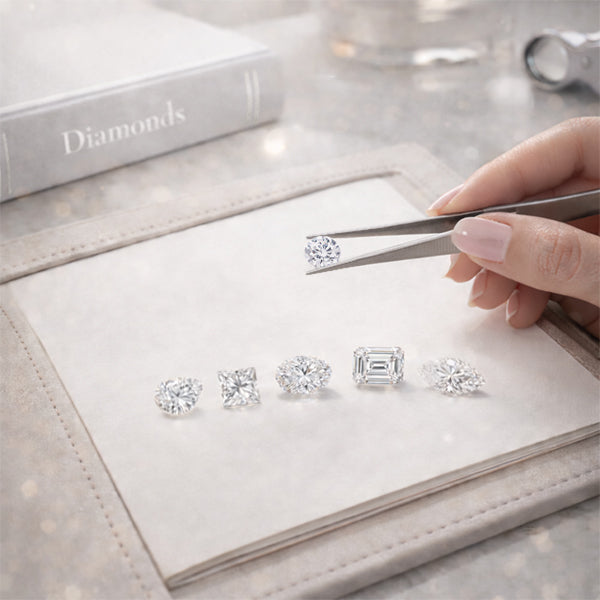
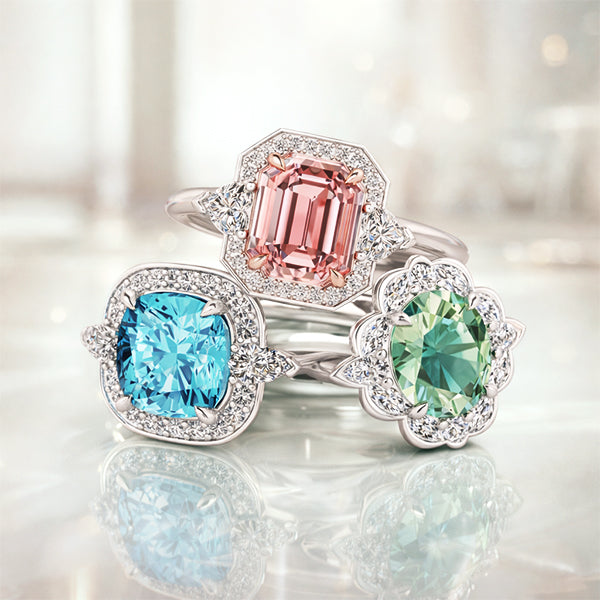
The outline or form of a diamond, such as round, princess, oval, or pear. Shape affects brilliance, perceived size, and style preference. Round brilliant cuts often offer the most sparkle, while fancy shapes can appear larger for the same carat weight.
A measure of a diamond’s weight, not its size. One carat equals 0.20 grams. Higher carat diamonds are rarer and command higher prices, but well-cut smaller stones can appear just as striking.
White diamond prices depend on the 4Cs—Carat, Colour, Clarity, and Cut—as well as market demand. Round diamonds usually cost more due to higher cutting wastage. Prices rise exponentially with higher carat weights and top-grade qualities.
Refers to the smoothness of the diamond's surface after cutting. Higher polish grades indicate fewer surface imperfections, enhancing the diamond’s brilliance.
The most critical factor for sparkle. A well-proportioned cut maximises light return and brilliance. Graded from Excellent to Poor, with ideal cuts showing exceptional fire and scintillation.
Refers to the precision of a diamond’s cut facets. Excellent symmetry improves sparkle and overall beauty, especially under magnification.
Graded from D (colourless) to Z (light yellow/brown). The less colour present, the rarer and more valuable the diamond. Near-colourless stones (G–J) offer excellent value with minimal visible tint.
The largest facet on a diamond, expressed as a percentage of its width. Ideal table size balances brilliance and fire, typically around 53–58% for round brilliants.
Refers to the presence of internal inclusions or external blemishes. Graded from Flawless (FL) to Included (I). Higher clarity enhances beauty and value, though many inclusions are invisible to the naked eye.
The height of the diamond from table to culet, shown as a percentage. Optimal depth ensures maximum light return without making the stone look small.
The diamond’s visible glow under UV light, ranging from None to Strong. Faint to Medium can enhance near-colourless stones; Strong fluorescence may affect transparency.
Reports detail colour origin (natural vs treated) and grading. GIA is highly respected for fancy colour grading consistency.
The angle between the girdle and crown facets. Ideal crown angles enhance fire and balance light return with brilliance.