






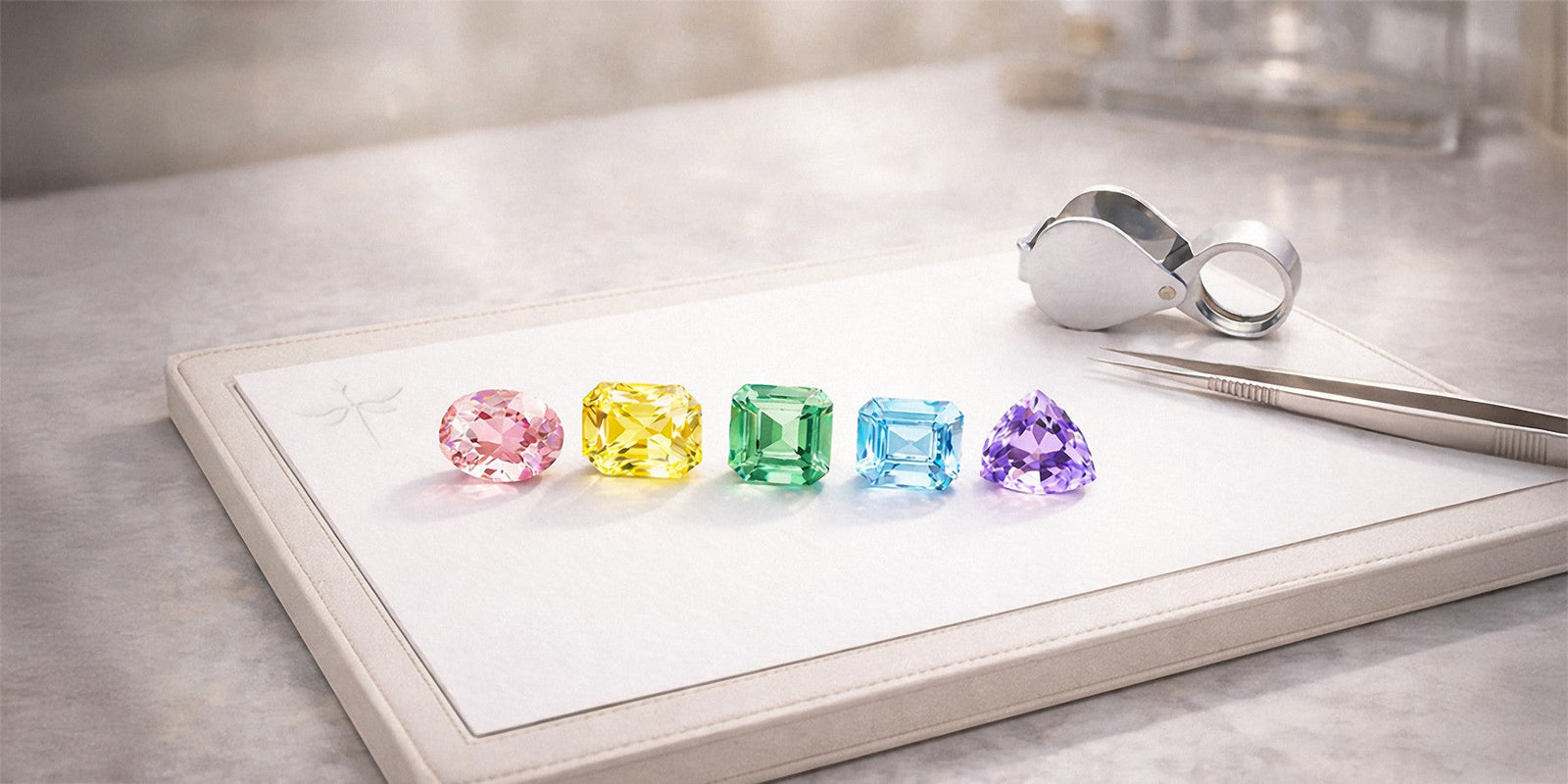

The Xemplare Guide to Buying Coloured Gemstones
Coloured gemstones have long enchanted jewellery lovers with their unique beauty, depth of character, and radiant individuality. Whether you're drawn to the velvety blues of sapphire, the vivid greens of emerald, or the regal purples of amethyst, selecting the perfect gemstone requires a blend of appreciation, knowledge, and discernment.
At Xemplare, we believe that understanding what makes a gemstone exceptional enhances not only its value—but your connection to it. Here's what to consider when choosing a coloured stone for your next heirloom-worthy piece.
1. Colour: The Soul of the Gem
When it comes to coloured gemstones, colour is everything. But it’s more nuanced than simply “red” or “blue”—true quality lies in a refined balance of hue, tone, and saturation.
Hue refers to the dominant colour and any secondary tints present. For example, a blue sapphire might lean slightly green or violet.
Tone describes how light or dark the stone is, from pale pastels to deep, dramatic shades.
Saturation speaks to intensity—how rich and vivid the colour appears. Exceptional stones have high saturation with little to no greying or browning.
Look for stones with even colour distribution, free from distracting zoning or patchiness. The most prized gemstones captivate with an uninterrupted flood of vivid, luminous colour.
2. Clarity: Beauty with Character
Unlike diamonds, coloured gemstones are often expected to have inclusions—tiny natural features formed within the earth. These inclusions can add uniqueness and even become part of a gem’s charm.
Emeralds, for example, are known for their inclusions (often called “jardin,” or garden), and are judged more gently than sapphires or rubies.
Still, avoid stones with excessive inclusions that cloud the gem or interrupt the light within it.
Ultimately, clarity should complement the stone’s beauty, not detract from it.
3. Cut: The Art of Illumination
A gemstone’s cut determines how it plays with light—how it sparkles, glows, or glimmers.
Seek out well-proportioned cuts that maximise brilliance and avoid the dreaded "window" effect (a pale, see-through centre).
Traditional cuts like oval, cushion, and emerald shapes are often used for coloured stones, but modern options like the princess cut can also enhance depth and vibrancy, particularly in darker stones.
The right cut elevates the gem’s natural allure—and ensures your jewellery dazzles from every angle.
4. Carat Weight: Quality over Quantity
Larger gemstones can be striking, but size alone does not determine value. A smaller stone with exceptional colour and clarity can far outshine a larger one that lacks brilliance.
Trust your eye—and your heart—when assessing a stone’s visual impact. The most valuable gems are those that combine beauty, rarity, and precision.
5. Treatments: Enhancements & Transparency
Many coloured gemstones undergo treatments to improve colour or clarity—such as heat treatment in sapphires or oiling in emeralds. These are widely accepted practices, but transparency is key.
Always ask:
What treatments has this stone received?
Are these enhancements permanent or temporary?
For peace of mind, significant purchases should be accompanied by documentation from a reputable independent gemological laboratory.
6. Trust the Source
Buy from a jeweller who is knowledgeable, transparent, and committed to ethical sourcing. A trusted supplier will:
Provide clear information on the gem’s origin and treatments
Offer certified stones from recognised gemmological institutes (such as GIA, GSL, AGL, or SSEF)
Stand behind the quality and authenticity of every piece
At Xemplare, we partner with the most respected sources and artisans to ensure your coloured gemstone is not only beautiful—but responsibly acquired and masterfully set.
7. Choose with Heart
Above all, let your choice reflect your own style, sentiment, and story. A gemstone should resonate with you—its colour, its presence, its energy. Whether you're marking a milestone, gifting love, or indulging in something truly extraordinary, trust your instincts.
Because at the end of the day, the finest gemstone is the one that feels like it was always meant to be yours.
Coloured Gemstones Overview— By Gemstone
This reference presents coloured gemstones organised by individual gemstone, allowing you to easily explore characteristics, durability and rarity at a glance.
Diamond
Colour Range: Colourless,Yellow, Brown, Pink, Blue, Green, almost every colour
Gem Family: Diamond
Mohs Hardness: 10
Transparency: Transparent - Opaque (Black Diamonds)
Rarity: Exceptional
Jewellery Use: High jewellery, investment pieces
Typical Origins Australia, Africa, Canada
Sapphire
Colour Range: Blue, Pink, Yellow, Green, Purple, almost any colour except red.
Gem Family: Corundum
Mohs Hardness: 9
Transparency: Transparent–Translucent
Rarity: Rare
Jewellery Use: Fine jewellery, engagement rings
Typical Origins Sri Lanka, Madagascar, Australia
Ruby
Colour Range: Red - Pinkish Red - Brownish Red
Gem Family: Corundum
Mohs Hardness: 9
Transparency: Transparent–Translucent
Typical Origins: Myanmar, Mozambique, Thailand
Rarity: Exceptional
Jewellery Use High jewellery, heirloom pieces
Emerald
Colour Range: Green
Gem Family: Beryl
Mohs Hardness: 7.5–8
Transparency: Transparent–Translucent
Typical Origins Colombia, Zambia, Brazil
Rarity: Rare
Jewellery Use: Fine jewellery, statement rings
Morganite
Colour Range: Peach, Pink
Gem Family: Beryl
Mohs Hardness: 7.5–8
Transparency: Transparent
Typical Origins: Brazil, Madagascar
Rarity: Rare
Jewellery Use: Fine jewellery, bridal
Aquamarine
Colour Range: Blue
Gem Family: Beryl
Mohs Hardness: 7.5–8
Transparency: Transparent
Typical Origins: Brazil, Nigeria
Rarity: Rare
Jewellery Use: Fine jewellery
Tsavorite Garnet
Colour Range: Vivid Green
Gem Family: Garnet
Mohs Hardness: 7–7.5
Transparency: Transparent
Typical Origins: Kenya, Tanzania
Rarity: Exceptional
Jewellery Use High jewellery
Spinel
Colour Range: Red, Pink, Blue, Purple
Gem Family: Spinel
Mohs Hardness: 8
Transparency: Transparent
Typical Origins: Myanmar, Sri Lanka, Tanzania
Rarity: Rare
Jewellery Use Fine jewellery
Tourmaline
Colour Range: Green, Pink, Blue, Orange, Mint, Lagoon andMulticolour
Gem Family: Tourmaline
Mohs Hardness: 7–7.5
Transparency: Transparent–Translucent
Typical Origins: Brazil, Afghanistan, Nigeria, Namibia
Rarity: Rare
Jewellery Use: Fine and contemporary jewellery
Paraíba Tourmaline
Colour Range: Neon Blue, Green
Gem Family: Tourmaline
Mohs Hardness: 7–7.5
Transparency: Transparent
Typical Origins: Brazil, Mozambique
Rarity: Exceptional
Jewellery Use: High jewellery
Zircon
Colour Range: Blue, White, Honey
Gem Family: Zircon
Mohs Hardness: 6–7.5
Transparency: Transparent
Typical Origins: Cambodia, Sri Lanka, Australia
Rarity: Rare
Jewellery Use: Fine jewellery
Opal
Colour Range: White, Blue, Green, Multicolour
Gem Family: Opal
Mohs Hardness: 5.5–6.5
Transparency: Translucent–Opaque
Typical Origins: Australia, Ethiopia
Rarity: Rare
Jewellery Use: Statement jewellery
Tanzanite
Colour Range: Blue-Violet
Gem Family: Zoisite
Mohs Hardness: 6–6.5
Transparency: Transparent
Typical Origins: Tanzania
Rarity: Exceptional
Jewellery Use Fine jewellery
Alexandrite
Colour Range: Green to Red (Colour Change)
Gem Family: Chrysoberyl
Mohs Hardness: 8.5
Transparency: Transparent
Typical Origins: Russia, Brazil, Sri Lanka
Rarity: Exceptional
Jewellery Use: Collector and high jewellery
Peridot
Colour Range: Green
Gem Family: Olivine
Mohs Hardness: 6.5–7
Transparency: Transparent
Typical Origins: Myanmar, Pakistan, USA
Rarity: Rare
Jewellery Use: Fine jewellery
Amethyst
Colour Range: Purple
Gem Family: Quartz
Mohs Hardness: 7
Transparency: Transparent
Typical Origins: Brazil, Uruguay
Rarity: Fine
Jewellery Use: Fine and fashion jewellery
Citrine
Colour Range: Yellow
Gem Family: Quartz
Mohs Hardness: 7
Transparency: Transparent
Typical Origins: Brazil
Rarity: Fine
Jewellery Use: Fine and fashion jewellery
Editorial Notes
• Natural inclusions are common and often embraced as part of a gemstone’s character.
• Rarity and origin can significantly influence long-term value and collectability.